
Activated Carbon Jacobi
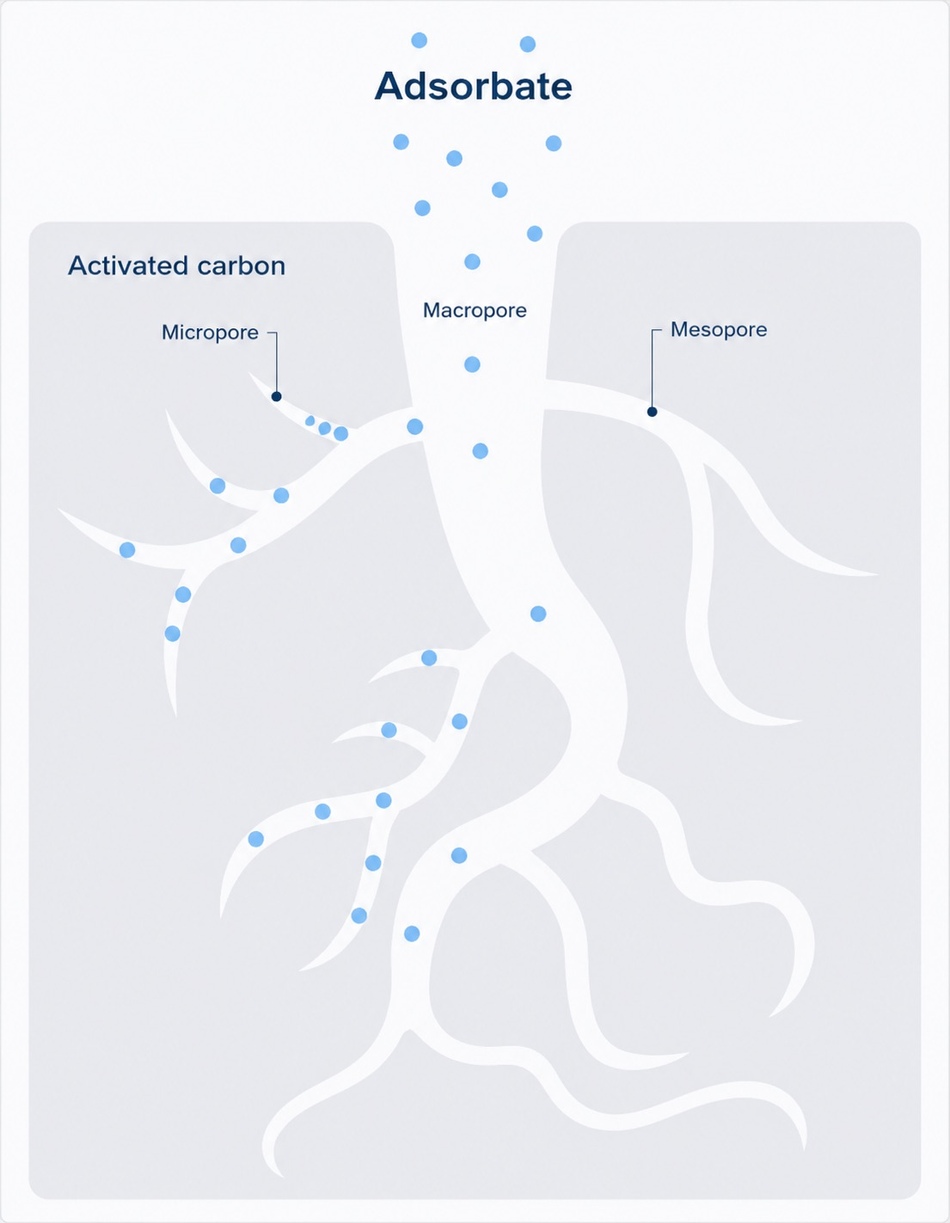
Activated carbon is a highly versatile adsorbent used in thousands of applications worldwide to remove contaminants from gas, air, and liquids, drinking water purification being one of the most critical applications.
Using raw materials such as wood, coconut shell, bituminous and anthracite coal, the basic carbonised raw material undergoes high temperature controlled steam or chemical activation to develop a vast internal porosity. This porosity, classified into micropores, mesopores, and macropores, drives a physical adsorption process, where van der Waals like forces attract pollutants from air, gas, or liquid to active sites within the developed pores of the activated carbon internal structure. Macropores function as transport highways. Mesopores continue the transport function and adsorb medium sized molecules and Micropores adsorb small molecules. The pore size distribution determines which pollutant the activated carbon can effectively remove.
If pores are too small, pollutants cannot enter; if too large, adsorption is weak. Therefore, the carbon must be selected so that its pore sizes match the molecular dimensions of the target contaminant.Different raw materials and activation processes yield distinct pore distributions, making this matching essential for optimal removal efficiency.