Sulphur Recovery Catalyst
MAXCEL® Claus Catalyst
Evonik’s comprehensive array of sulphur recovery catalysts are backed with technical support and customer service that is second to none. Maxcel® quality catalysts and expert services help keep your sulphur recovery operations running smoothly and efficiently – so the rest of your refinery can, too.
MAXCEL® 727 - spherical activated alumina catalyst designed specifically for the Claus reaction and optimal H2S conversion.
- High surface area.
- Mass transfer benefits provided by high macroporosity of 0.2cc/g.
MAXCEL® 727HD – high density spherical activated alumina catalyst designed specifically for use in liquid sulphur degassing contactors
MAXCEL® 740 - spherical activated alumina / iron oxide promoted Oxygen protection catalyst
In sulphur recovery units with fired reheaters, oxygen ingress can cause significant Claus catalyst deactivation. This deactivation occurs due to sulphation, the formation of a stable aluminum sulphate layer on the Claus catalyst active sites. However, this deactivation can be mitigated by including a small guard layer of Maxcel® 740 in the top of the catalyst bed.
Maxcel® 740 is a true oxygen catalyst, not an oxygen scavenger.Maxcel® 740 will not become “saturated” with oxygen. Instead, Maxcel® 740 facilitates the reaction of trace oxygen with sulphur compounds present in the gas. By converting this oxygen before it comes into contact with the pure alumina catalyst below, the effects of catalyst deactivation by sulphation can be reduced. Maxcel 740 is typically installed in the second and third Claus converter when fired reheaters are present upstream
MAXCEL SD-A - for sub-dew point Claus processes
Spherical activated alumina Claus SRU catalyst tailored for optimum H2S conversion and recovery in sub-dew point applications. High surface area and high macroporosity result in improved performance and longer catalyst life.
MAXCEL® 777- extruded Titania Claus Catalyst
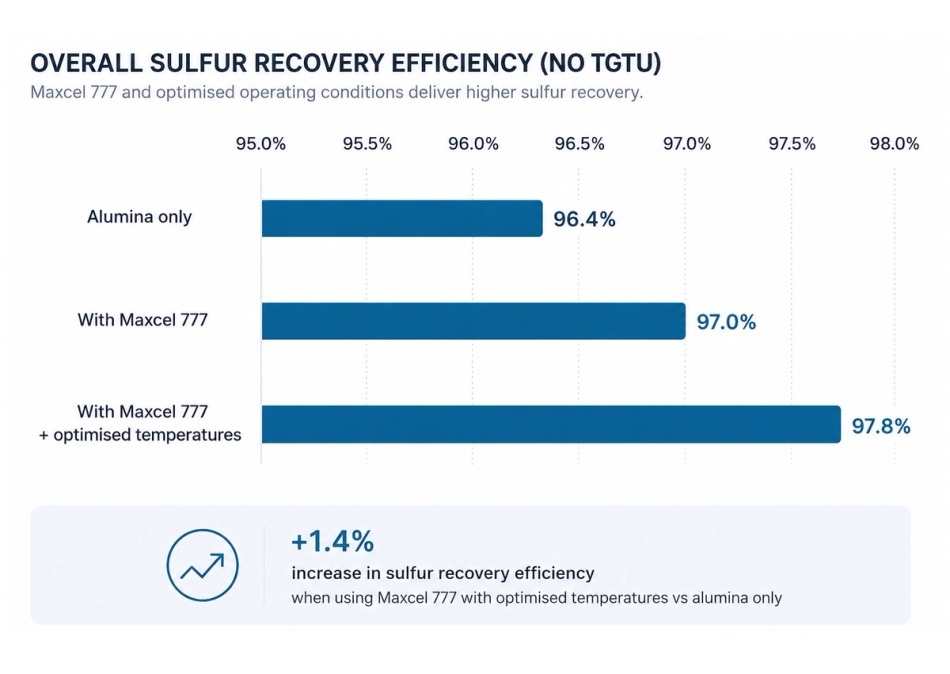
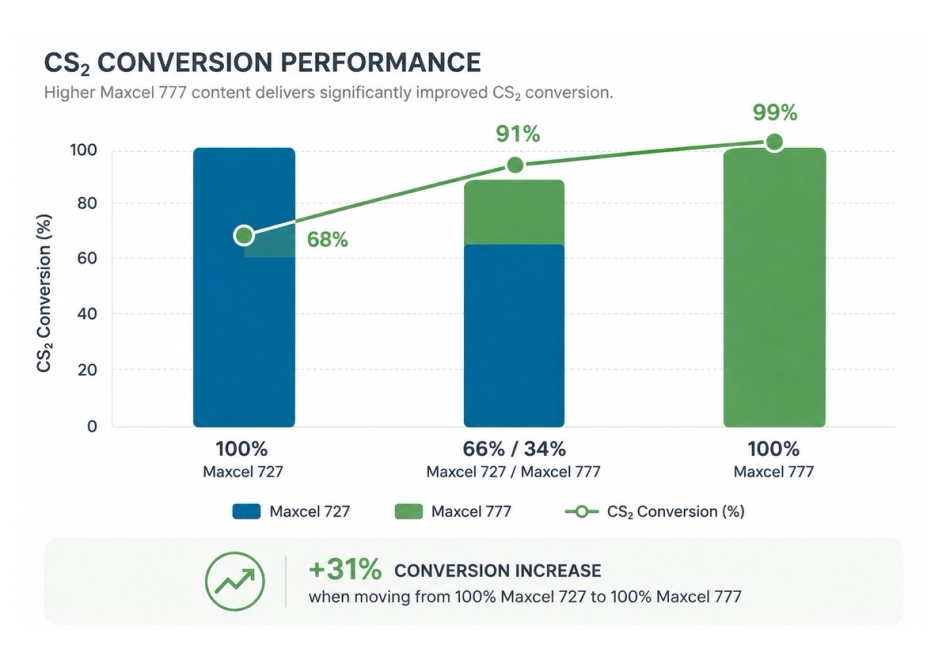
Evoniks Maxcel 777 is a titanium oxide-based sulfur recovery catalyst, and is used to achieve nearly complete hydrolysis of COS and CS2 while also allowing Claus reaction to proceed to equilibrium. This combined effect results in very high overall sulfur conversion efficiency, and no change in start-up procedure is required. Titania catalyst can be applied in various ways to provide improvements in unit operability and efficiency.
Maximize COS and CS2 conversion
Maxcel 777 may be implemented in the first Claus reactor to convert COS and CS2 by hydrolysis, thereby preventing their contribution to emissions (as would occur in a direct oxidation or sub-dew point tail gas process). Maxcel 777 may be installed in either a portion or the full volume of the first Claus reactor; Porocel customizes bed loading configurations based on the extent of COS and CS2 conversion required.
- High conversion efficiency with near complete hydrolysis of COS and CS2 yielding low tail gas sulphur content
- Operate at lower temperatures with lower emissions
- Superior resistance to sulphation poisoning and hydrothermal aging gives longer life cycle length
- Allows higher space velocities for the same sulphur conversion, which may result in smaller Claus SRU reactor volumes for new or retrofit units.
Typical EOR Performance of Catalyst Beds
The Claus reaction is an exothermic equilibrium-limited reaction, which means that as temperature increases, conversion decreases. The conversion of COS and CS2 by hydrolysis are both kinetically-limited reactions, which means that as temperature increases, conversion increases. Maxcel 777 enables the Claus unit operator to optimize unit operation to achieve high conversion of both categories of reaction by decreasing the temperature required to achieve sufficient COS and CS2 conversion.